
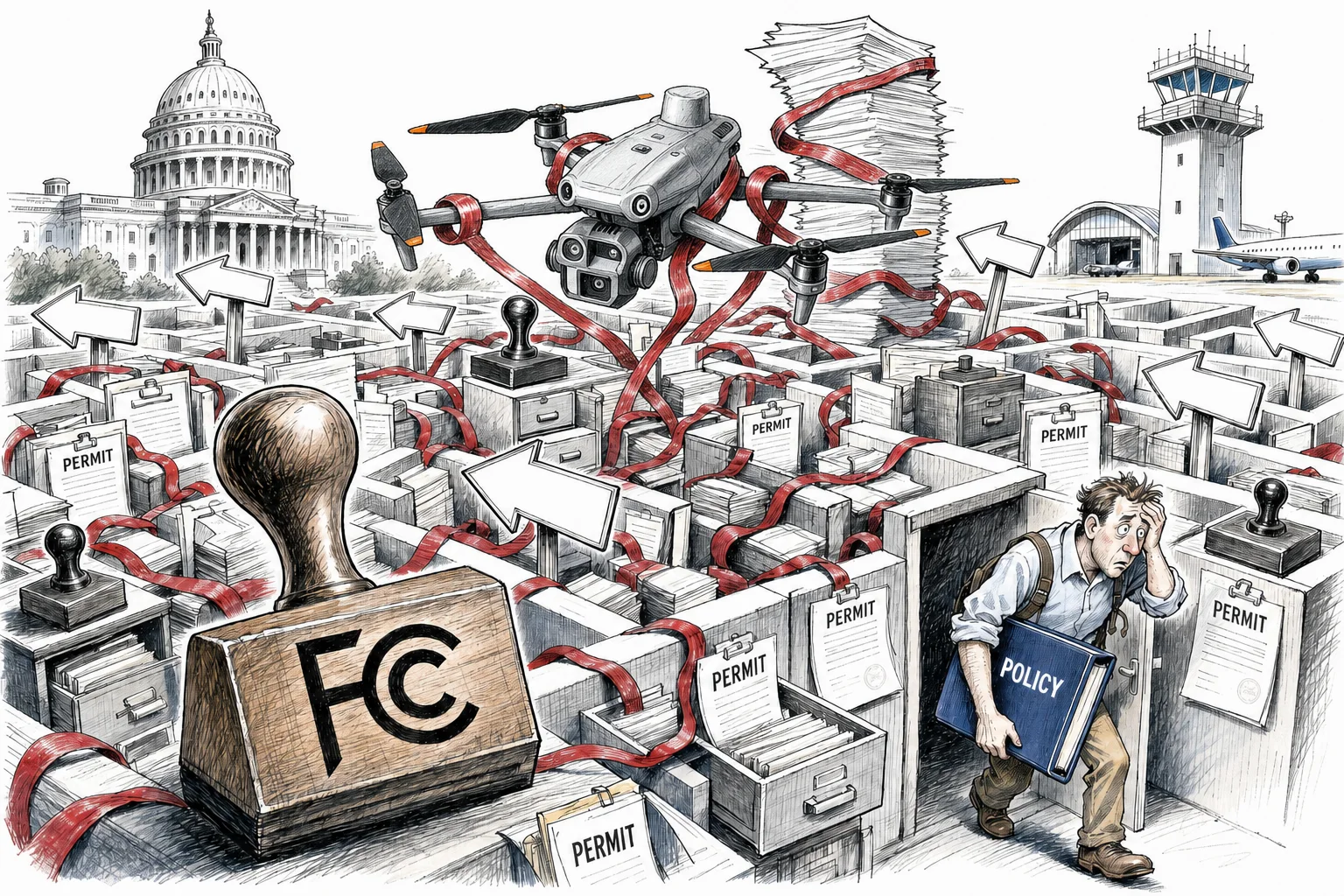
“Retroactive” does not mean grounded. It still matters.
The July 21 FCC notice, DA 26-758, opened the proposal in PS Docket 26-189. The notice proposes a restriction on the continued importation and marketing of certain equipment that already holds an FCC authorization. The agency describes the target as previously authorized, covered, foreign-produced UAS and critical components that meet its proposed military-grade definition. In this article, “26-189” always refers to the docket, not an FCC order number.
The proposal reaches previously granted equipment authorizations. That is the retroactive element. It uses the FCC's authority to limit an existing authorization without necessarily revoking the underlying authorization.
The notice says continued use or operation of already-purchased UAS would not be affected by this proposed import-and-marketing restriction.
The notice does not provide a model-by-model list or a quantified inventory of aircraft and components that would fall within each capability category.
The proposal is not, by itself, proof that every DJI aircraft will be remotely disabled, made unlawful to possess or immediately prohibited from flight.
The operator consequence sits between those extremes. A drone can remain legal to operate while its commercial ecosystem narrows. New imports can stop. Dealers can lose future stock. A model or critical component may become harder to replace. Buyers can discount residual value. Lenders, insurers or enterprise clients can treat regulatory uncertainty as risk. A business owner deciding whether to add a second aircraft, standardize a payload or promise a three-year service contract must plan around that uncertainty now.
The definition is the policy
The FCC's proposed categories combine military applications with ordinary civil capabilities. The notice asks whether the categories are too broad and whether listed capabilities may not actually be military-grade. That invitation is where field evidence matters.
- 55 pounds or more
- Reaches larger enterprise and heavy-lift platforms, regardless of whether the mission is military.
- Thermal sensors
- Common in fire response, search and rescue, roof and solar inspection, utility work and law enforcement.
- LiDAR-capable sensors
- Could reach mapping payloads, range-finding systems and LiDAR-based obstacle sensing on enterprise and consumer aircraft. The FCC notice does not name individual models or require a mapping mission.
- Docking stations
- Central to drone-as-first-responder, remote inspection and automated site-monitoring programs.
- Dispersal systems
- Can sweep in crop spraying and other agricultural applications while invoking weapon-delivery concerns.
- Swarming capability
- Raises a definition problem: coordinated commercial fleets and defense swarms can use overlapping technical building blocks.
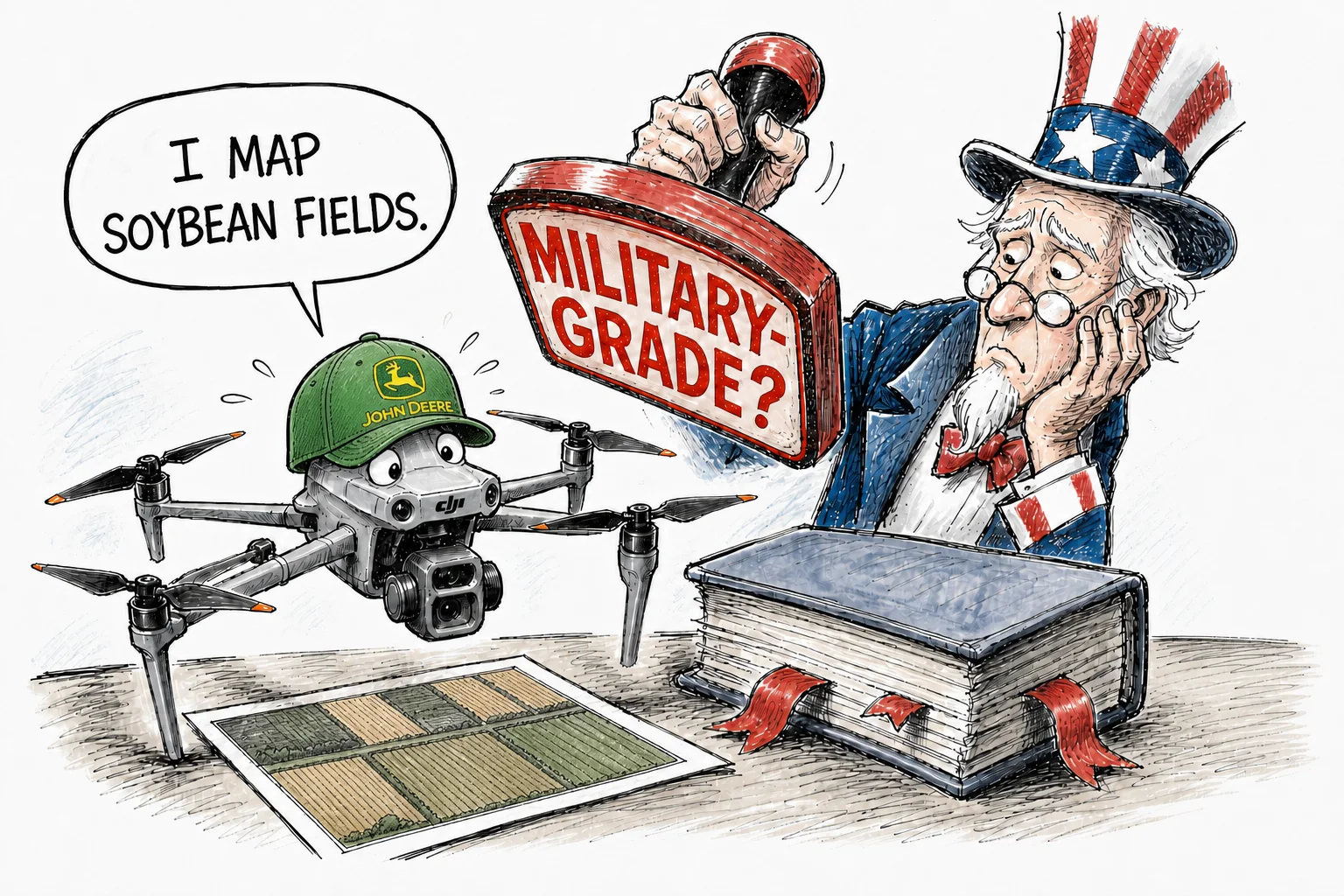
This can reach a backpack camera drone, not only an enterprise payload
DJI's own consumer support materials identify forward-facing LiDAR on the Mini 5 Pro, Air 3S, Mavic 4 Pro and Neo 2, and on the Avata 360. DA 26-758 defines its proposed category as covered UAS that “contain or integrate sensors capable of” LiDAR. It does not require survey-grade mapping, a defense mission or enterprise branding. On the face of those specifications, these consumer models are plausible candidates for the LiDAR category if they are also previously authorized and covered. The FCC has not published the model-specific determination needed to say which would ultimately be restricted.
Obstacle sensing is not automatically LiDAR. DJI's Mini 4 Pro specification lists binocular vision and a bottom 3D infrared sensor, while the Avata 2 specification lists downward and backward visual positioning plus time-of-flight sensing. Those specifications do not place those two models in the LiDAR category. Newer members of both consumer families do: Mini 5 Pro and Avata 360. The distinction must be made model by model.
The separate Toy Drone exemption is not a general exemption for recreational camera drones. A device must satisfy every listed criterion, including no GPS or GNSS, no imaging or sensing, no app or network connectivity, no brushless motors and a takeoff weight at or below 150 grams. The notice nevertheless tentatively reasons that recreational consumers are unlikely to fly “military-grade” UAS and that economic impacts should be minor. The consumer LiDAR inventory is a concrete reason to test that assumption before a final action.
Record the exact model and FCC ID, then read the official sensing specification for the word “LiDAR.” If it is present, save the specification and document the ordinary use case, purchase price, replacement reliance and requested remedy. A short model-specific filing in PS Docket 26-189 is stronger than a generalized ban claim.
Enterprise systems remain clearly implicated too. DJI's Matrice 400 is marketed with integrated rotating LiDAR and millimeter-wave radar for obstacle sensing. DJI's Matrice 4D ecosystem offers an obstacle-sensing module combining rotating LiDAR and radar. The Matrice 4 Series also uses laser range finding and visual obstacle avoidance. Taken together, the official specifications demonstrate why operators need a model-and-component matrix, not a slogan. They do not establish how the FCC will classify each product in a final action.
This rule also cannot be read alone. The American Security Drone Act separately restricts federal agency procurement, operation and the use of federal funds for covered systems. Section 1709 of the FY2025 NDAA creates a separate DJI and Autel pathway and listing backstop. Meanwhile, DA 26-761 extends relief for qualifying Blue UAS and Buy American equipment through January 1, 2028, but it does not rescue equipment independently listed under Section 1709.
Five open windows, one industry that cannot afford to miss them
At the August 10 evidence cutoff, five federal comment or reply dates were approaching. The dockets move independently, so operators should verify each date in the live record before filing.
DJI security assessment
DA 26-592, ET Docket 26-22. Comments on DJI's OnDefend assessment inside the reconsideration record.
Named covered equipment
DA 26-742, PS Docket 26-184. Proposed limits on certain previously authorized equipment.
Military-grade foreign UAS
DA 26-758, PS Docket 26-189. Proposed import and marketing restriction after a 180-day period. An extension request was pending at the cutoff.
Where equipment is produced
FCC 26-50, ET Docket 21-232. Production-location definitions and related authorization rules.
Production-location replies
FCC 26-50, ET Docket 21-232. Reply comments on the production-location definitions and related authorization rules.
Live docket check, August 10: the five published deadlines above still stand. The extension request in PS Docket 26-189 remains pending; no FCC order acting on it was present in the live record. A separate August 10 notice, DA 26-832, opened an Anzu-specific proposal in PS Docket 26-184, with comments due 30 days after Federal Register publication. That new clock had not started at this cutoff.
Volume is not the same as evidence, but participation matters. In two August 10 snapshots of PS Docket 26-189, controlled screening found no supportive express comment. The larger same-day snapshot contained 415 express comments. The defensible wording is “none found,” not “none exists”: the docket was still changing, attachments are not always machine-readable and the corpus was not exhaustively hand-coded.
Visible opposition dominated the reviewed express-comment record
PS Docket 26-189, same-day August 10 snapshot. Counts describe screening results, not a public-opinion poll.
Method: three text detectors, followed by manual reading of support candidates. “Opposition language” is not a complete classification of every comment. Source: adjudicated FCC docket corpus.
DSPA's Vic Moss explains why a specific comment matters now
Vic Moss, CEO and co-founder of the Drone Service Providers Alliance, published a 35-minute operator walkthrough of PS Docket 26-189. He says he, Kenji Sugahara and Kyle Nordfors met with FCC national-security adviser Adam Chan on July 30 about the proposal. That meeting account is attributed to Moss; it was not independently confirmed in the reviewed docket materials.
The actionable part of his message aligns with the notice itself: the FCC asks specific questions about economic and supply-chain consequences, and drone service providers can answer with their own fleet, mission, cost and availability evidence. His urgency is an advocacy perspective, not a forecast we present as measured fact.
What you can do now
Put operator evidence into the record before policy hardens
One documented fleet, one comparable quote or one mission-specific declaration is more useful than a hundred recycled claims. Choose the action that fits your role.
| Deadline at Aug. 10 cutoff | Proceeding | Best fit for your evidence | Live record |
|---|---|---|---|
| Aug. 28, 2026 | ET 26-22 DA 26-592 | Evidence addressing DJI's OnDefend security assessment and the reconsideration record. | Open docket |
| Aug. 31, 2026 | PS 26-184 DA 26-742 | Previously authorized equipment associated with named covered entities. | Open docket |
| Sept. 2, 2026* | PS 26-189 DA 26-758 | Thermal, LiDAR, docking, agricultural, swarming, weight, cost, supply and transition evidence. | Open docket |
| Sept. 8, 2026 | ET 21-232 FCC 26-50 | Definitions for where equipment and components are produced. | Open docket |
| Sept. 21, 2026 | ET 21-232 replies FCC 26-50 | Reply to filed arguments about production-location definitions and related authorization rules. | Open docket |
*The September 2 date remains subject to a pending extension request; no order acting on it was present in the live docket on August 10. DA 26-832 also queued an Anzu-specific comment window in PS 26-184, but its Federal Register clock had not started. Check each live docket before filing and identify the correct proceeding and notice.
Do not send another slogan. Send the missing record.
The strongest operator response is not “security does not matter.” It is a mission-specific evidence package that makes the transition cost, capability gap and workable safeguard impossible to ignore.
Build this in 48 hours
- Inventory the operating stack. Aircraft, payloads, controllers, batteries, docks, software, remaining service life and current replacement availability.
- Describe missions, not brands. Annual flights; thermal searches; mapping acreage; utility miles; emergency response; launch time; accuracy; wind, night and GNSS requirements.
- Price the real transition. Comparable configured quotes, software, training, batteries, accessories, integration, procurement lead time and expected downtime.
- Identify the exact policy trigger. Docket, model, component and proposed category. Separate FCC marketing limits from federal funding and fleet restrictions.
- Propose a measurable remedy. Model-specific determination, mission carve-out, delayed transition, bridge funding, security control, network mode or independently validated alternative.
- Protect sensitive operations. FCC filings are public. Aggregate or redact tactical locations, vulnerabilities and personally identifiable information.
Make these policy asks
- Publish a model-and-component matrix for every proposed capability category, including consumer obstacle-sensing systems.
- Release the full DHS complex-urban DJI results and comparable future protocols.
- Produce an auditable installed-base, mission-risk and replacement-cost assessment.
- Require the same cybersecurity and reliability disclosures from every manufacturer.
- Fund realistic bridge, retraining and replacement pathways before deadlines take effect.
- Require conflict, methodology and financial-interest disclosure when private survey or certification data shape policy.
File relevant comments through the FCC Electronic Comment Filing System. Find federal representatives through Congress.gov and state officials through USA.gov.
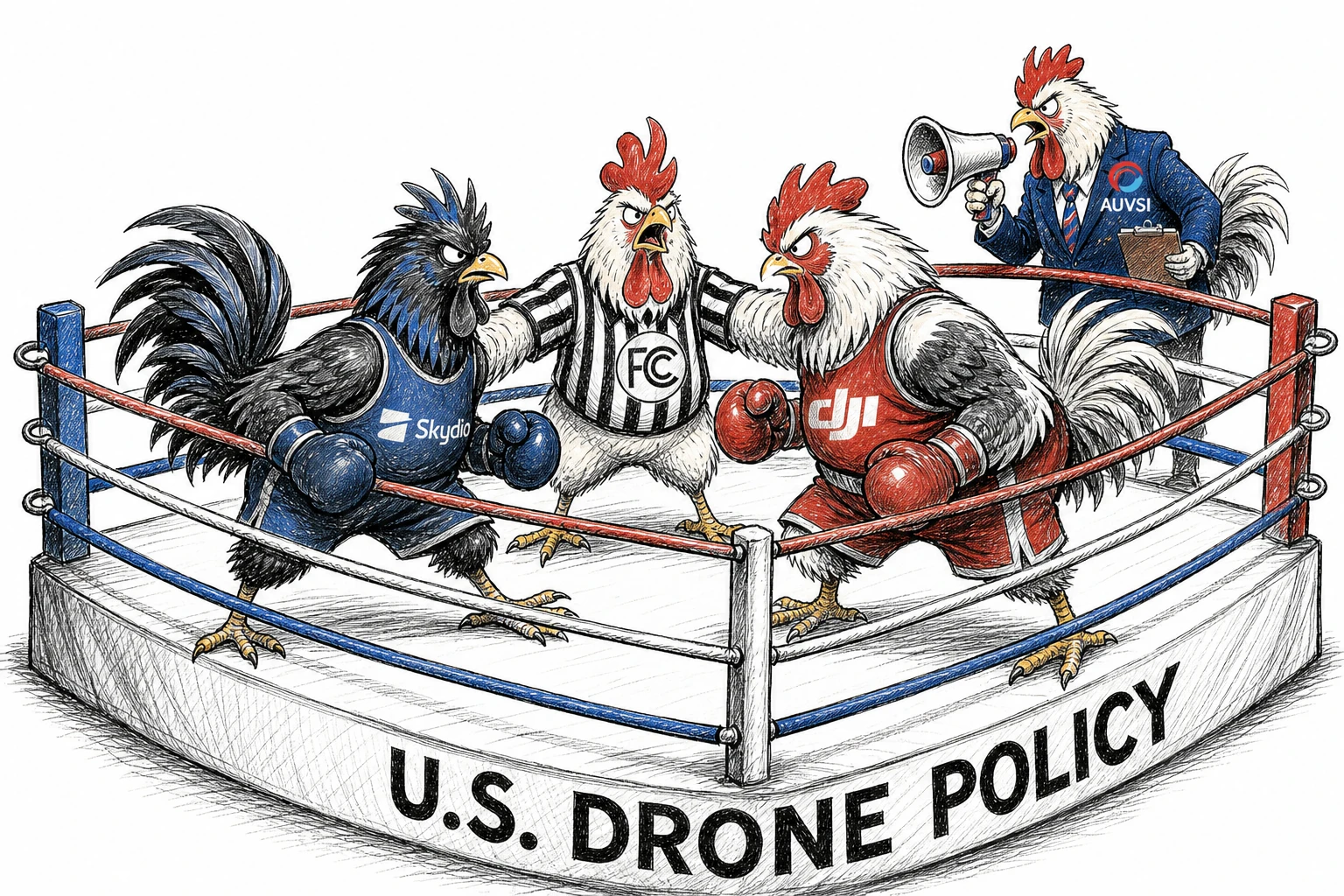
DHS ran the comparison policymakers keep asking for. The public got only part of it.
This is the most actionable new finding in the research.
In a complex-urban assessment conducted in New York City, DHS's National Urban Security Technology Laboratory put seven UAS through familiarization and attempted operational evaluation in Hudson Yards. Five were compliant or Blue-list systems: Ascent AeroSystems Spirit, Freefly Astro, Parrot ANAFI USA GOV, Skydio X10D and Teal 2. Two were covered-nation systems: DJI Matrice 30T and DJI Matrice 4T.
Before formal scoring, a proficient remote pilot tested whether each aircraft could maintain position in degraded GNSS, building obstruction, multipath and urban wind. Four were deemed stable enough to fly: both DJI aircraft, the Skydio X10D and the Parrot ANAFI USA GOV. The Spirit, Astro and Teal 2 could not maintain position sufficiently for the first-responder use case in that setting, so they were not operationally scored.
“Results related to the covered nation platforms ... are available to public safety agencies upon request.”
The public QuickLook reports overall scores of 3.7 for the Skydio X10D and 2.4 for the Parrot. It does not publish the DJI scores. Public-safety agencies are directed to request the covered-nation results from NUSTL@hq.dhs.gov.
| Aircraft and tested configuration | Reported price | Position hold gate | Public overall score |
|---|---|---|---|
| Ascent AeroSystems Spirit | $56,195 | Not sufficient | Not scored |
| Freefly Systems Astro | $47,018 | Not sufficient | Not scored |
| Skydio X10D with VT300-Z and NightSense | $28,382 | Sufficient | 3.7 / 5.0 |
| DJI Matrice 30T | $18,608 | Sufficient | Available on request* |
| Teal Drones Teal 2 | $15,073 | Not sufficient | Not scored |
| Parrot ANAFI USA GOV | $13,964 | Sufficient | 2.4 / 5.0 |
| DJI Matrice 4T | $12,958 | Sufficient | Available on request* |
Prices are the DHS-published prices for the stated test configurations, based on GSA pricing where applicable or procurement quotes. They are not normalized bills of material. *DHS did not publish covered-nation results to the general public, but states they are available to public-safety agencies. Source: DHS SAVER complex-urban QuickLook, Jan. 16, 2026.
In the DHS configuration set, price did not determine who could be scored
Reported price in U.S. dollars. Pattern indicates the position-hold gate result in this test, not universal product quality.
- Passed position-hold gate
- Did not pass position-hold gate
The two highest-priced configurations were among the three that could not be operationally evaluated in Hudson Yards. This does not establish that they fail in other environments, payloads, firmware versions or configurations.
The most fileable action in this piece
If you represent a public-safety agency, request the full covered-nation results from NUSTL@hq.dhs.gov. Ask for the Matrice 4T and Matrice 30T overall and category scores, evaluator comments, test protocol, configuration, software versions, weighting, anomalies and any dissemination restrictions.
For a public release, request the same material through the DHS FOIA process. Identify the document as the “Blue UAS for First Responders in Complex Urban Environments Assessment,” published as SAVER-T-QL-8 on January 16, 2026.
DHS did conduct a same-environment comparison that included DJI. Both DJI platforms cleared the initial flight-safety gate in that assessment. The two most expensive tested configurations did not.
The QuickLook does not establish a universal brand winner, prove security safety or show how the DJI systems scored. Position hold is one operational gate, not a total procurement decision.
Policy is being made while decision-relevant federal performance data remain outside the general public record. Agencies and operators can ask for that record now.
The transition is national. The public evidence is not.
Security concerns do not need to be imaginary for implementation to be poorly measured. The reviewed record contains a national policy direction without a national operating inventory.
What is reasonably established
- Many public-safety and commercial programs depend on DJI equipment.
- Foreign-produced systems dominate parts of the civil market.
- Federal rules and funding limits can change procurement even where operation remains legal.
- Domestic and compliant alternatives are improving, but equivalence is mission-specific.
What is still missing
- A current national count by model, payload, mission and remaining service life.
- An auditable replacement-cost model with training, software, batteries and downtime.
- Comparable field tests across mission environments.
- A vendor-neutral incident denominator based on flight hours and causal severity.
The most repeated fleet statistic comes from a 2020 DRONERESPONDERS survey. More than 90 percent of respondents to one multi-select brand question reported some DJI use. But only 257 people answered that question, and the survey was self-selected. It is evidence of dependence among respondents. It is not proof that DJI represents 90 percent of public-safety aircraft, agencies or flight hours nationally.
Florida is often used as a cost proxy. Its replacement program received $25 million. That is a real appropriation, not a $200 million proof point and not a national estimate. A useful national model would count the entire operating stack: aircraft, thermal or mapping payload, controller, batteries, charging, docks, software seats, training, maintenance, data migration, integration and service interruption.
Public-safety testimony supplies real mission detail but cannot substitute for a census. NYPD Deputy Commissioner Kaz Daughtry testified that DJI outperformed alternatives the department had tested and said local department data had not been compromised. Chula Vista's police chief described a specific optical requirement that only a DJI Matrice 300 met at the time. Those are operational accounts. They are not universal rankings or cybersecurity audits.
The appropriate response is not to pretend the gap settles the security question. It is to require a transparent, vendor-neutral transition record before irreversible deadlines. A domestic industrial strategy will be stronger, not weaker, if its products win on comparable performance, security, availability and total cost.
State fleets show the cost before a national count exists
A February 2026 Oregon Department of Aviation white paper collected responses from 25 state transportation and aviation programs about federal-aid restrictions on covered UAS. It is the best multi-state operating snapshot located in this review. It is not a standardized nationwide census, and it should not be used as one.
Transportation and aeronautics responses in one point-in-time state survey.
Explicit affected counts, using 25 as the midpoint of Indiana's reported 20 to 30 range.
Aircraft reported grounded for federal-aid work in the state that assembled the survey.
Some programs reported a dollar loss; others reported replacement quotes, appropriations, or no budget at all. Those are different accounting measures. The most defensible statement is that the explicit state responses establish a floor of at least 467 affected airframes across 23 reporting entities. Illinois and Washington supplied qualitative impacts without a count, and four responding states reported zero current impact.
Explore the verified state findings
Select a state tile or use the menu. Dark red marks an explicit affected-aircraft count in the Oregon transportation survey; blue marks a qualitative response; green marks a responding program that reported zero impact. Florida is gold because its state and local public-safety evidence comes from a separate policy lane. Gray means this review found no state-specific number, not zero impact.
- Explicit affected count
- Qualitative response
- Respondent reported zero
- Separate state/local case
- No verified number in this review
The tile map is a navigation aid, not a choropleth or a national estimate. State colors describe only the reviewed source status. A gray state may have an affected fleet that was not captured in these sources.
Open the complete state evidence table
| State and evidence lane | Affected aircraft or share | Reported cost or operating effect | Boundary |
|---|---|---|---|
| Alabama · transportation | 16; 75% | $15,000 to $30,000 estimated per replacement | State respondent estimate |
| Alaska · transportation | 65 of 130 | $1.8m reported loss; about $3.9m replacement | Program figures, not statewide all-agency totals |
| Arkansas · transportation | 5 | Aircraft affected | No comparable cost supplied |
| California · transportation | 91 of 307 | State UAS operations restriction noted Dec. 22, 2025 | Transportation-program response |
| Colorado · transportation | 16; about 90% reported | Five small UAS remained | Percent and unit descriptions are respondent-supplied |
| Florida · state/local public safety | Broward 63; Miami-Dade 41; Lee County 38 of 41; Orange County 18 replaced | $300,000 Broward and more than $200,000 Miami-Dade original purchase values; $150,000 Lee request; nearly $580,000 Orange replacement with nearly $400,000 reimbursed; $25m state program | Different accounting measures from separate agencies and reports; do not sum as a statewide census or uniform replacement cost |
| Georgia · transportation | 34; about 80% | About $225,000 reported | Program estimate |
| Idaho · transportation | 8 of 16 | $30,000 reported; one replacement example rose from about $15,000 to more than $42,000 | Example is not a fleetwide unit price |
| Illinois · transportation | Qualitative impact | No explicit unit count supplied | Included as a respondent, excluded from the 467 floor |
| Indiana · transportation | 20 to 30; 85% | About $400,000; no replacement budget reported | 467 floor uses midpoint 25 |
| Kansas · transportation | 5 | About $65,000 | Program estimate |
| Kentucky · transportation | 2 | Aircraft affected | No comparable cost supplied |
| Maryland · transportation | 0 reported | No current impact reported | Zero for this respondent and policy lane only |
| Massachusetts · transportation | 2 | Aircraft affected | No comparable cost supplied |
| Minnesota · transportation | 60 identified; 84% foreign-produced | Segmented fleet impact | Foreign-produced share is not itself a universal grounding rate |
| Nebraska · transportation | 13; 86% | About $45,000 | Program estimate |
| New York · transportation | 23 of 25 | Restricted on federal projects | Not an all-missions grounding statement |
| Oregon · transportation | 21 of 22 active | Grounded for federal-aid work | Not a statewide all-agency census |
| South Carolina · transportation | 0 reported | No current impact reported | Zero for this respondent and policy lane only |
| Tennessee · transportation | 14 | Aircraft affected | Separate state law is procurement-focused |
| Texas · transportation | 0 reported | No current impact reported | Zero for this respondent and policy lane only |
| Utah · transportation | 64 of 70 | About $735,000 fiscal note | Program and legislative estimate |
| Virginia · transportation | 2 | Aircraft affected | No comparable cost supplied |
| Washington · transportation | Qualitative impact | No explicit unit count supplied | Included as a respondent, excluded from the 467 floor |
| Wisconsin · transportation | 1; 100% | Entire reported fleet affected | Small denominator: one aircraft |
| Wyoming · transportation | 0 reported | No current impact reported | Zero for this respondent and policy lane only |
Primary multi-state source: Oregon Department of Aviation, Feb. 28, 2026. Florida sources: FDLE replacement program, Broward and Miami-Dade reporting, Lee and Collier reporting, and Orange County replacement reporting. Counts and dollar types are source-specific snapshots.
Follow the money, but do not make it say more than it does
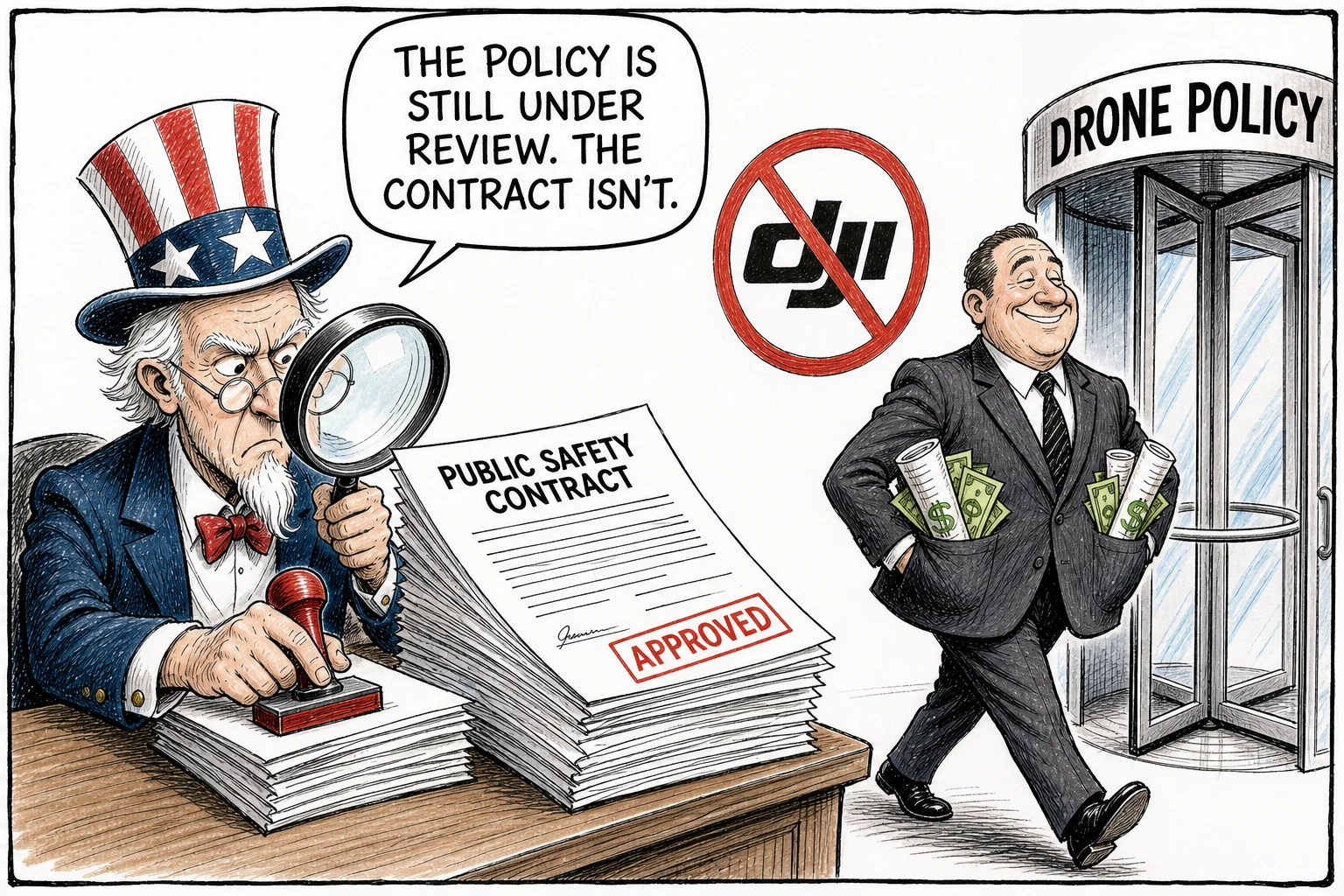
There are beneficiaries, lobbyists and politically connected investors around the policy shift. The records justify scrutiny. They do not, by themselves, identify who caused a federal decision.
Federal contracting: two ledgers, two different Skydio stories
Skydio's direct-prime federal obligations fell 27.2 percent from fiscal 2024 to fiscal 2025, before the December 2025 Covered List action. A broader product-identifiable series that includes reseller and channel awards reached $39.0 million in partial fiscal 2026, above any prior full year in the reviewed data. Both measures can be true because they answer different questions. Neither is Skydio revenue.
The $151 billion Missile Defense Agency SHIELD figure is a shared contract ceiling across more than 2,400 holders. It is not a Skydio award. The located Skydio child order was $500.
No federal prime obligations to Unusual Machines were found in the reviewed USAspending record through the evidence cutoff. That does not rule out subcontracts, reseller sales or future awards.
Lobbying: money proves attention and access, not instruction
Amendment-corrected reported Lobbying Disclosure Act amount fields totaled about $19.94 million for DJI and $4.98 million for Skydio over the reviewed periods. A conservative non-overlap construction produced about $11.63 million for DJI and $3.61 million for Skydio. The difference illustrates why a lobbying total must travel with its aggregation rule.
Lobbying totals change with the accounting construction
Millions of reported LDA amount fields across reviewed periods. These are not comparable to company revenue and do not prove policy causation.
Source: reviewed Senate LDA filings with amendments reconciled. A client expense can overlap with a retained firm's income. The conservative series reduces, but cannot eliminate, every comparability issue.
DJI's filings frequently name China and the Countering CCP Drones Act. None of the 69 reviewed Skydio filings mentions DJI or China, and the FCC Covered List appears by name only beginning in late 2025. That undercuts the most direct version of the claim that Skydio's public filings show it lobbying specifically to ban DJI. It does not mean Skydio had no policy interest in domestic-drone restrictions.
AUVSI's amount-bearing filing fields total $7.20 million raw and $6.887 million after exact-period duplicate correction. Neither should be called unique cash spending because trade-association expenses and retained-firm income can overlap. The correct description is “reported amount fields.”
AUVSI has overlapping roles. That is a disclosure problem, not proof of a rigged test.
AUVSI is a trade association, a registered lobbying client, a convener of advocacy committees and the owner of the fee-bearing Green UAS program. Green participants can share completed assessment materials for potential Blue UAS consideration. These roles create a structural interest in the standards, funding and market transition it discusses.
| Documented role | Why it matters | What it does not prove |
|---|---|---|
| Membership trade association | Represents companies that can gain or lose from procurement and security rules. | That every member agrees or controlled an advocacy position. |
| Registered lobbying client | Directly participates in federal policy advocacy. | That a specific official acted at its instruction. |
| Green UAS program owner | Collects published assessment fees and shapes a compliance pathway. | That an assessment result was manipulated. |
| Potential bridge to Blue consideration | Creates market value around successful completion and reusable assessment material. | Automatic Blue approval or government delegation of Blue-list authority. |
The appropriate response is transparency: publish the survey instruments used in advocacy, the sampling frame, response rate, sponsors, weighting, relevant governance interests, program revenue, assessor payments, recusals, appeals and aggregate remediation outcomes. That is a stronger safeguard than claiming corruption without evidence.
The Trump-family and drone-capital connections are real. The causation claim is not.
Donald Trump Jr. invested in Unusual Machines before becoming an adviser. A later SEC registration statement listed 331,580 beneficial shares for resale, including warrants and advisory restricted stock units. In February 2025, Donald Trump Jr. and Eric Trump became advisers and significant stockholders of Dominari Holdings. Dominari later took placement-agent and investment-manager roles across a network that includes Unusual Machines and financing vehicles connected to Powerus and Xtend.
| Connection | Supported by the reviewed record | Boundary |
|---|---|---|
| Donald Trump Jr. → Unusual Machines | Investment, advisory role and disclosed beneficial securities. | No reviewed record proves he directed FCC or congressional action. |
| Donald and Eric Trump → Dominari | Advisory roles and significant stockholder status reported in company filings. | Advisory status does not establish transaction-level control. |
| Dominari → drone financings | Placement-agent and investment-manager roles across identified transactions and vehicles. | No reviewed record establishes that the Trump sons received a specific drone transaction fee. |
| Policy shift → domestic-drone valuations | Restrictions on foreign supply can improve opportunity for domestic alternatives. | Benefiting from policy does not prove causing policy. |
The chronology matters. The federal security and industrial-policy trajectory began years before these investments: defense procurement restrictions appeared in the FY2020 NDAA; the Secure Equipment Act became law in 2021; and the American Security Drone Act was enacted in 2023. Politically connected capital entered a market already being redirected.
The strongest supported explanation is convergence. National-security law, domestic-manufacturing policy, lobbying, certification and capital incentives pull in the same direction. Convergence can create powerful beneficiaries and deserving questions without establishing a secret coordination mechanism.
Transaction-specific compensation, introductions, policy contacts, beneficial interests, relevant communications and recusals would materially strengthen or weaken the theory. Until obtained, they remain records to seek, not facts to invent.
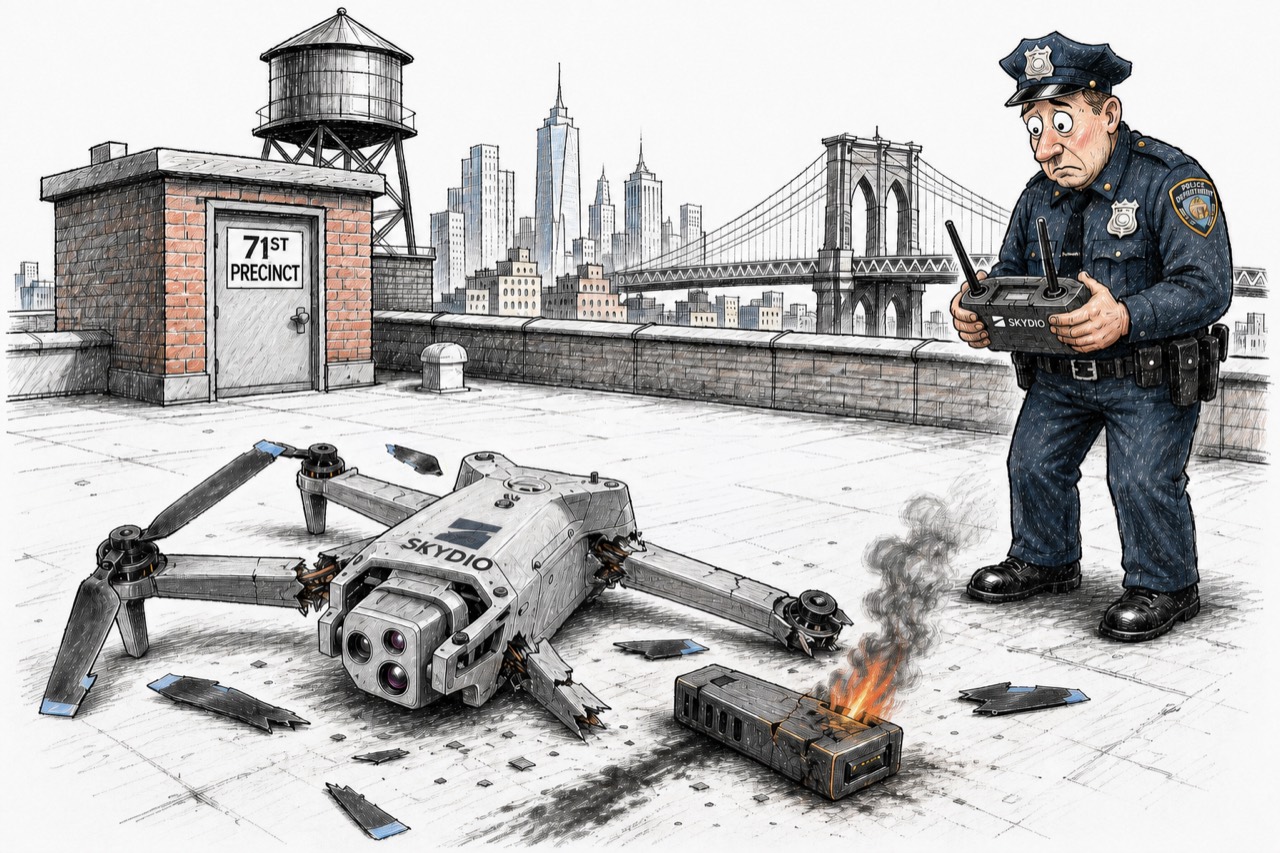
Skydio's own notices document real X10 failure modes
Operators' reports about substitute platforms deserve more than dismissal or amplification. They are a reason to open the manufacturer's notices, ask for configuration-specific history and price the risk into procurement. They are not a defensible failure rate by themselves.
Skydio's public Notices to Operators document multiple X10 and X10D conditions capable of ending a flight or forcing a landing. The rates below are Skydio's owner-reported estimates, not independent measurements, and several changed as the fleet and software evolved.
Open the Skydio source records: five operator notices and three U.S. cases
| Published condition | Possible flight outcome | Owner-reported frequency | Published mitigation or boundary |
|---|---|---|---|
| Flight-control system failure | Controls can become unresponsive, followed by unrecoverable motor power loss and a crash. | About 1 in 55,600 flights | Root cause remained under investigation in the reviewed notice; later software added safety and reliability changes. |
| Uncommanded battery reset | In-flight power loss. | About 1 in 20,000 flights | Fleetwide drone, controller and battery update; unupdated batteries were flight-blocked. |
| Battery-level estimation error | Rapid displayed drop, premature landing or failure to return. | About 1 in 1,500 overall; 1 in 300 below 30% | Software correction; applies to X10 and X10D in the notice. |
| Accelerated REV1 propeller-hub wear | Loss of synchronization, unrecoverable upset and crash. | No rate stated | REV2 design and replacement program; operators must identify the installed revision. |
| Battery-connector wear | Power loss; in the cited event the battery ejected and caught fire. | One triggering Dock Beta event described | Online monitoring and offline inspection guidance; manufacturer's root-cause account. |
These notices establish known, product-specific conditions and mitigations. They do not establish that every aircraft is affected, that each reported crash had the same cause, or that another brand is safer without comparable exposure and severity data.
Three U.S. events operators should be able to find before procurement
Dock Beta crash and battery fire
Skydio says an X10 lost power after battery-connector wear, crashed, ejected the battery and caught fire. The root-cause statement is the manufacturer's.
Snohomish tree strike, crash and fire
A South County Fire pilot packet described a tree strike, crash and fire during its drone-as-first-responder pilot. The factors were preliminary and full telemetry was unavailable.
NYPD X10 fall and battery fire
A Skydio X10 fell near the FIFA fan zone in Brooklyn Bridge Park and its battery burned. Public accounts conflicted, and no event telemetry or final government cause was located.
The procurement standard operators should demand from every vendor
Flight hours by model and software version; mission aborts; loss-of-control events; power losses; forced landings; collisions; injury, fire and property severity; technical, human and environmental causal classification; corrective action; open safety notices; and the share of fleet represented by the denominator.
Known X10 conditions belong in a procurement file when policy pushes operators toward substitute platforms. They do not support a panic claim or a clean cross-brand reliability ranking. They support configuration checks, current mitigations and comparable exposure-normalized disclosure from every vendor.
There are alternatives. There is no single replacement.
The links below are procurement starting points, not endorsements and not a claim of one-for-one DJI equivalence. “Available” can still mean a specific configuration, payload, software plan, authorization, lead time or government-list status. Operators should compare the complete mission stack and open safety notices before signing a quote.
BRINC Responder
Drone-as-first-responder and emergency response
Evaluate launch infrastructure, thermal and communications requirements, response radius, data controls and delivery timing.
Parrot ANAFI USA
Rapid deployment, inspection and public safety
A variant appeared in the DHS urban comparison. Match the exact government or commercial configuration to the intended policy lane.
Skydio X10 / X10D
DFR, inspection and close-environment autonomy
Open the current Notices to Operators, verify every installed mitigation and distinguish online X10 from offline X10D evidence.
Freefly Astro Max
Mapping, inspection and payload integration
Compare payload, positioning, environmental and workflow requirements. The tested Astro configuration did not pass DHS's Hudson Yards position-hold gate.
Inspired Flight IF800
Inspection, mapping and swappable payloads
Price the configured payload, batteries, ground station, software and training, not the base airframe alone.
WingtraRAY
Large-area mapping and survey workflows
Assess takeoff and landing space, payload, processing stack, LiDAR option, field repair and mission-specific accuracy.
Hylio agricultural systems
Crop application and agricultural operations
Evaluate capacity, application workflow, service network, software, batteries, exemptions and the full economics of switching a spray program.
Compare the configuration, not the badge
Confirm the current Blue UAS cleared-list or other required authorization for the exact configuration; payload and data-path compliance; offline capability; positioning and obstacle behavior; open manufacturer notices; batteries and charging; software and data migration; training; repair network; delivery time; and total five-year cost. A listing can change, and a listed base system does not automatically validate every payload or mission.
How this was built, and where it stops
Two large research runs were compared claim by claim. The U.S.-scoped companion ledger contains 160 adjudicated claims with preserved source provenance. Ten consequential decisions received a separate adversarial challenge, and six were modified or overturned. A final visual inspection caught a stale-code error that automated gating had missed, leading to corrected DHS pricing and a standing requirement that rendered figures be inspected, not merely built.
The investigation uses five evidence states: verified for direct primary support; measured for a reproduced corpus or calculation; owner-reported for a party's statement about itself; inferred for a conclusion drawn from disclosed facts; and unresolved for a documented reason to investigate further.
What this investigation does not claim
- It does not claim national-security risk is imaginary or that any foreign platform is universally safe.
- It does not claim DJI won the unpublished DHS scoring. The public record does not contain those scores.
- It does not claim Skydio, AUVSI, the Trump sons, Dominari or domestic manufacturers secretly directed the FCC.
- It does not treat lobbying totals, investment, membership, contracts or policy benefit as proof of a quid pro quo.
- It does not provide legal advice or guarantee how a final FCC action will classify a model or component.
Records that could change the story
The covered-nation DHS scores; a national mission-level fleet inventory; complete transition-cost data; comparable vendor incident denominators; AUVSI survey instruments and Green UAS financial and recusal records; transaction-specific adviser compensation and policy contacts; reseller and subcontract data; and relevant federal communications obtainable under public-records law.
Primary records and research files
FCC notices, statutes and rules
- DA 26-758, proposed military-grade UAS import and marketing restrictions
- DA 26-742, PS Docket 26-184
- DA 26-592, DJI OnDefend security-assessment comment window
- DA 26-761, Blue UAS and Buy American relief through 2028
- DA 26-588, narrow Toy Drone exemption and definition
- FCC 26-50, production-location proceeding
- FY2025 NDAA, Public Law 118-159, Section 1709
- FY2024 NDAA and American Security Drone Act
- 47 C.F.R. § 2.803, marketing of radio-frequency devices
- 47 C.F.R. § 2.939, limitation or revocation of authorization
Testing, operations and market evidence
- DHS SAVER Blue UAS for First Responders landing page
- DHS complex-urban assessment QuickLook
- 2020 DRONERESPONDERS survey report
- Florida drone replacement program
- DJI Matrice 400 official capability page
- DJI Dock 3 and Matrice 4 obstacle sensing module specifications
- DJI consumer forward-facing LiDAR support page
- DJI consumer obstacle-avoidance system matrix
- DJI Mini 4 Pro sensing specifications
- DJI Avata 2 sensing specifications
State fleet impacts, failure notices and replacement options
- Vic Moss / DSPA operator walkthrough of PS Docket 26-189
- Oregon aviation 25-state federal-restrictions white paper
- Broward and Miami-Dade fleet reporting
- Lee and Collier County replacement reporting
- Skydio Notices to Operators directory
- X10 flight-control system failure notice
- X10 uncommanded battery-reset notice
- X10 and X10D battery-level estimation notice
- X10 accelerated propeller-hub wear notice
- South County Fire DFR pilot incident packet
- Brooklyn X10 crash and battery-fire report
- DIU Blue UAS cleared list